Erasmus University
World-class education programs in medicine and health sciences.
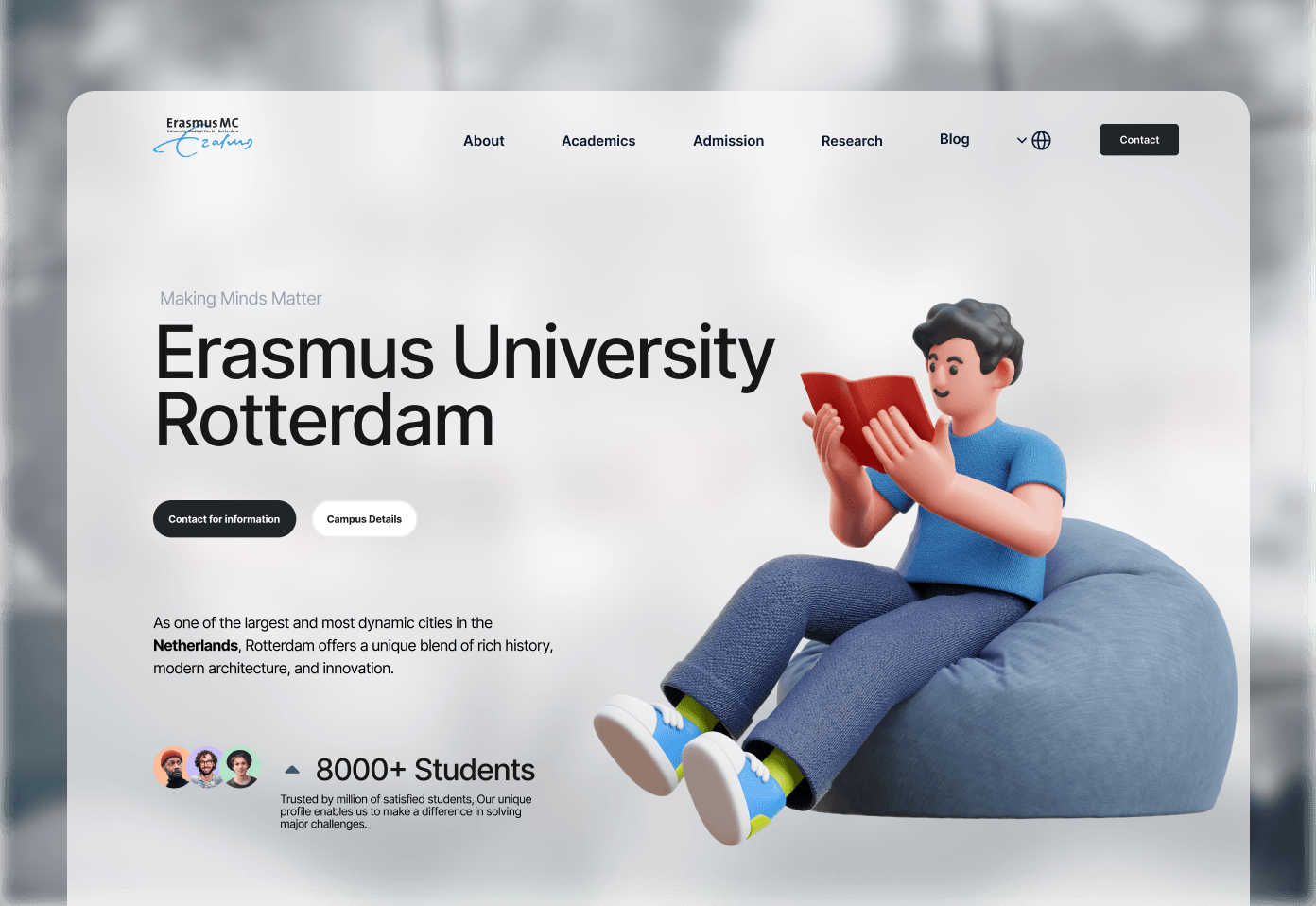
Project overview
Erasmus University is World-class education programs in medicine and health sciences.. Empowering Future Health Innovators Through Excellence in Medical Education. Built with high standards for performance, security, and intuitive user experiences, the platform is engineered to support mission-critical workflows and seamless scale.
What was the problem or pain point
Client Dilemma & Technical Bottleneck
Erasmus University Rotterdam, renowned for its medical and business faculties, needed a next-generation interactive digital learning platform for remote clinical case studies and medical team simulations. Traditional video conferencing tools (Zoom, Teams) were inadequate for medical training: they lacked interactive diagnostic canvases, could not synchronize high-resolution radiological DICOM scans, and failed to track student diagnostic decision trees in collaborative small-group sessions.
What we suggested to the client
Solid Sphere Architectural Recommendation
Solid Sphere proposed developing a dedicated medical collaborative learning platform. We recommended building a low-latency multi-user virtual clinical training room combining WebRTC peer-to-peer audio/video with an interactive shared Canvas whiteboard, synchronized medical imaging viewers, and automated case decision analytics for faculty evaluation.
What made this project challenging
Transitioning complex clinical medical examination and anatomy coursework into virtual environments
Enforcing high-security online examination protocols with biometric identity verification
Supporting interactive high-resolution 3D medical imaging and histological slide viewing in browsers
Handling thousands of concurrent medical students during university-wide examination periods
What was implemented and how it was implemented
Step-by-Step Technical Execution
We developed the web platform using React and TypeScript on the frontend, with a Node.js and PostgreSQL backend. We integrated HTML5 Canvas API and WebSockets to create a collaborative diagnostic workspace where students and clinical instructors can view high-resolution patient case charts, annotate diagnostic scans in real time, and vote on clinical treatment paths. We implemented WebRTC for high-fidelity, low-latency audio and video communication within small break-out medical simulation groups. We built an automated case assessment engine that records student decision timelines against clinical gold standards, providing professors with detailed performance analytics on diagnostic accuracy and teamwork speed. The entire platform was packaged with Docker to ensure compliance with European privacy laws (GDPR) and university LMS integration via LTI standards.
How we delivered
Engineered secure browser-based medical examination environment with lockdown features
Built interactive deep-zoom histology slide viewer utilizing HTML5 Canvas and tile slicing
Integrated WebRTC proctoring channels with encrypted session recording and automated audio monitoring
Developed automated grading engine for clinical scenario assessments and multiple-choice modules
What did we use to implement it
Technology Stack & Technical Rationale
React and TypeScript delivered an interactive clinical simulation interface with high rendering performance. HTML5 Canvas API enabled real-time multi-user annotation and medical image review. WebRTC provided peer-to-peer video and audio conferencing without third-party dependencies. Node.js with WebSockets synchronized collaborative canvas state and diagnostic decision timelines. PostgreSQL stored student evaluations, clinical case studies, and university department rosters. Docker ensured isolated, compliant deployments.
Key outcomes
Over 15,000 medical students examined digitally with zero system failures
Reduced grading turnaround time from 3 weeks to 24 hours
Supported European medical accreditation compliance
Seamless integration with university LMS infrastructure
Have a project like this?
Share your goals and constraints. We'll respond with next steps and a practical proposal.