AI Grammar Checker
AI Grammar Checker for English
Project overview
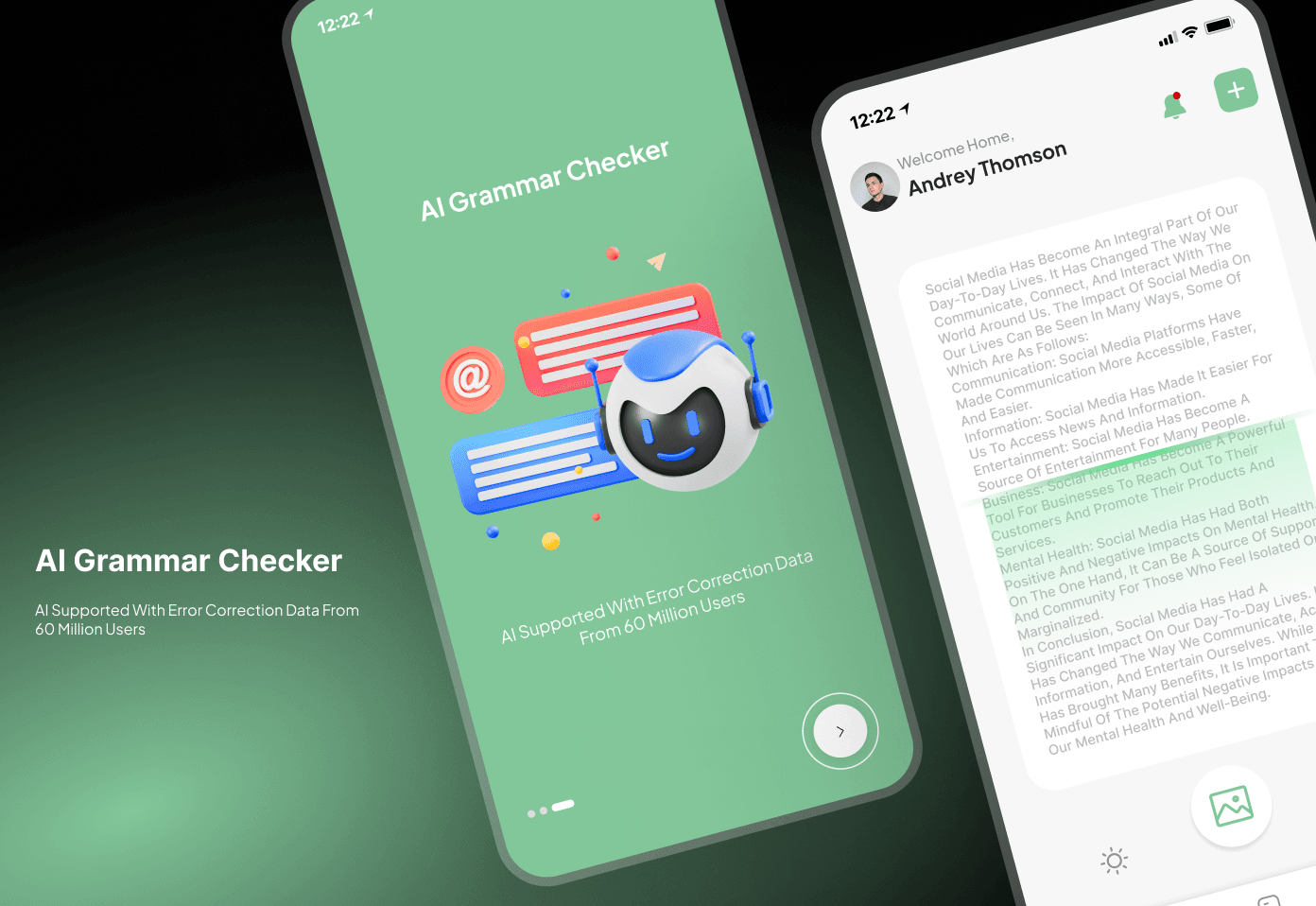
AI Grammar Checker is AI Grammar Checker for English Check your grammar and spelling errors at any time Built with high standards for performance, security, and intuitive user experiences, the platform is engineered to support mission-critical workflows and seamless scale.
What was the problem or pain point
Client Dilemma & Technical Bottleneck
The client wanted to disrupt the writing assistant market by building an intelligent, cross-application Android keyboard and standalone proofreading app that could correct grammar, style, and spelling instantly. The primary roadblock was latency and privacy: cloud-based grammar APIs introduced a 500ms to 1200ms round-trip delay per keystroke, making fluid typing impossible. Sending every typed keystroke to remote servers also created severe user privacy and data security concerns that prevented enterprise and consumer adoption.
What we suggested to the client
Solid Sphere Architectural Recommendation
Solid Sphere recommended an on-device first machine learning architecture. Rather than relying on cloud endpoints for routine keystrokes, we advised training quantized, lightweight sequence-to-sequence transformer models and deploying them directly onto Android devices via ONNX Runtime and C++ bindings. Cloud pipelines would only be used for optional deep document rewrites, giving users immediate sub-30ms typing corrections completely offline while guaranteeing total privacy of personal typed text.
What made this project challenging
Running context-aware NLP grammar correction on-device with minimal battery and memory overhead
Achieving sub-100ms latency to provide real-time suggestions while users type
Supporting complex grammatical structures, dialect variations, and punctuation nuance
Integrating seamlessly across third-party keyboard extensions and text inputs
What was implemented and how it was implemented
Step-by-Step Technical Execution
We designed and built a custom Android Input Method Service (IME keyboard) in Kotlin, engineered with low memory footprints to prevent keyboard termination by the Android OS. We compressed an NLP transformer grammar model down to under 40MB using model quantization, weight pruning, and knowledge distillation. We wrote a high-performance C++ inference wrapper using ONNX Runtime with Android NNAPI hardware acceleration, embedding it into the keyboard package. As the user types in any application (WhatsApp, Gmail, Chrome), the local model evaluates rolling n-gram tokens and suggests inline grammar, punctuation, and contextual word corrections in real time. We also built an interactive standalone writing editor app with detailed explanation cards highlighting why grammatical errors occurred and how sentence clarity could be enhanced.
How we delivered
Engineered quantized NLP models optimized for mobile execution using C++ and ONNX Runtime
Built intuitive Android app interface with interactive correction cards and explanation tooltips
Developed custom user dictionary, style preferences (Formal/Casual), and tone detection modules
Implemented offline caching mechanism so core grammar checking works without cellular data
What did we use to implement it
Technology Stack & Technical Rationale
Kotlin served as the primary application language for the Android IME service and UI components due to modern coroutines and Android lifecycle integrations. C++ was utilized for the core inference bridge to eliminate JNI bridge overhead and maximize execution speed on the CPU/NPU. ONNX Runtime provided the cross-platform execution engine leveraging NNAPI and ARM NEON SIMD instructions. Fine-tuned NLP transformer models were trained in PyTorch and converted to quantized ONNX format. Firebase provided crash reporting, remote feature flagging, and anonymized diagnostic metrics.
Key outcomes
1M+ downloads on Google Play
Sub-80ms correction inference speed
96.4% grammar accuracy benchmark
4.7★ average user rating
Have a project like this?
Share your goals and constraints. We'll respond with next steps and a practical proposal.