Starryai
AI Photo Generator
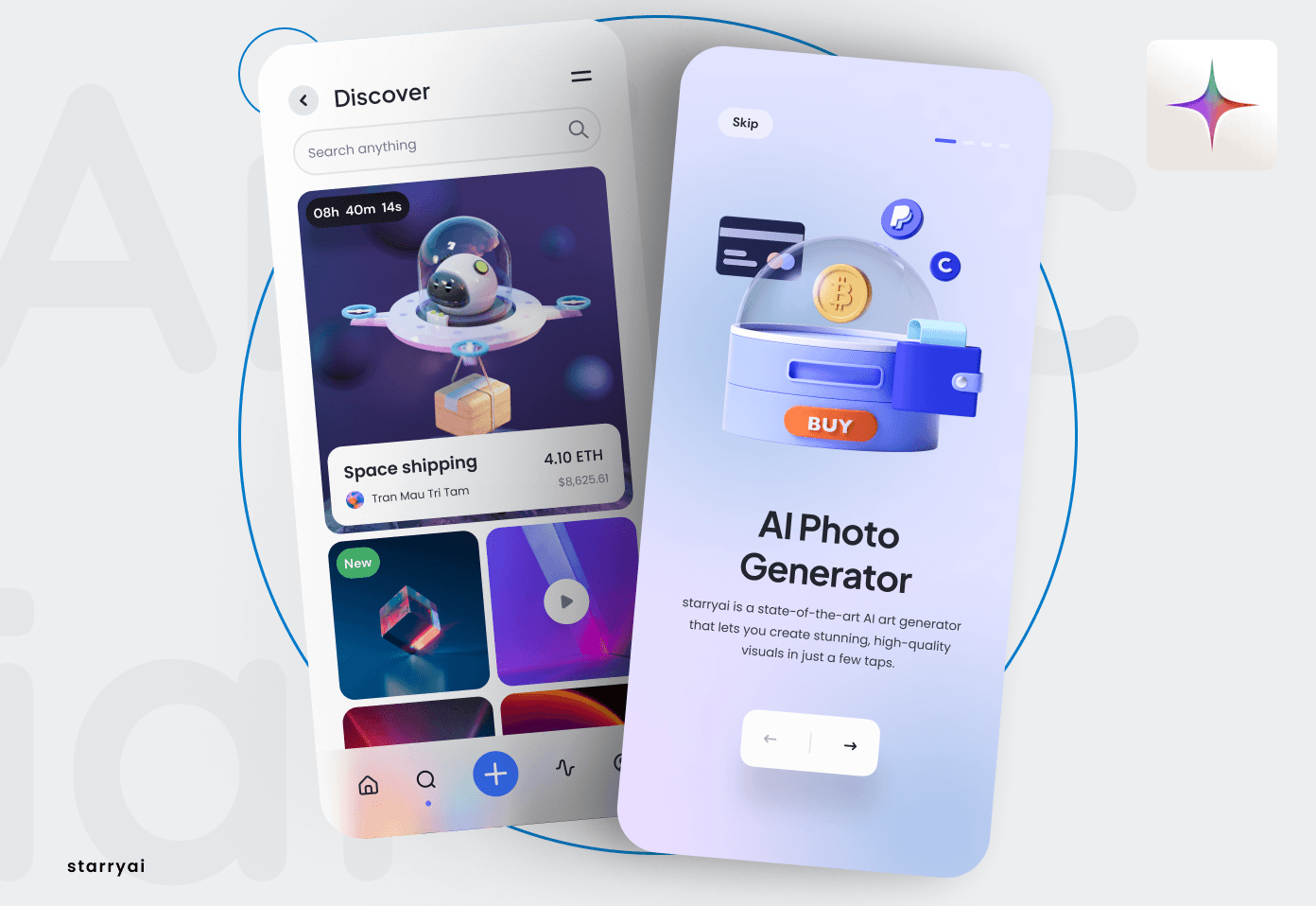
Project overview
Starryai is AI Photo Generator starryai is a state-of-the-art AI art generator that lets you create stunning, high-quality visuals in just a few taps Built with high standards for performance, security, and intuitive user experiences, the platform is engineered to support mission-critical workflows and seamless scale.
What was the problem or pain point
Client Dilemma & Technical Bottleneck
Starryai's founding team had a compelling vision: make professional-grade AI art generation accessible to everyday consumers on their smartphones. The core pain point was that existing generative AI tools were either locked behind expensive subscriptions on desktop platforms, required deep technical knowledge to operate, or suffered from multi-minute generation times that killed user engagement. On mobile, the challenge was even steeper — GPU-intensive diffusion model pipelines simply weren't designed to run efficiently on ARM chips or route requests fast enough from a mobile client to a cloud inference backend. The team also lacked a scalable way to handle sudden viral traffic spikes, having experienced crashes after a single TikTok post sent hundreds of thousands of concurrent users to their early prototype.
What we suggested to the client
Solid Sphere Architectural Recommendation
Solid Sphere recommended a hybrid on-device / cloud inference architecture rather than a purely server-side approach. We proposed building native iOS and Android applications with GPU-accelerated rendering using Apple Metal and Android Vulkan, while offloading the computationally intensive diffusion model inference to a fleet of auto-scaling AWS GPU instances. We advised the team to implement a pre-warming strategy for GPU workers so that cold start latency would be invisible to users. For the unique retouch feature, we suggested an on-device inpainting canvas that could send masked regions to the cloud pipeline rather than processing entire images, dramatically reducing network payload sizes and improving perceived speed.
What made this project challenging
Running multi-model generative AI pipelines with sub-second latency for mobile users
Building a custom touch-canvas retouch feature allowing users to erase and inpaint artifacts in real time
Scaling inference infrastructure dynamically during viral TikTok and social media spikes
Optimizing memory consumption on mid-range Android devices during 4K image upscaling
What was implemented and how it was implemented
Step-by-Step Technical Execution
We began by establishing the cloud inference backbone on AWS, provisioning G4dn GPU instances running ONNX-optimized versions of the diffusion models. A custom dispatch queue worker was built in Python that handled request prioritization, pre-warming idle GPU instances during off-peak hours, and auto-scaling based on queue depth metrics. On the iOS side, we built the application in Swift leveraging CoreML for on-device preprocessing steps like prompt tokenization and image resizing, before handing inference off to the cloud. The Android application mirrored this architecture using Kotlin with Vulkan-backed OpenGL for the rendering layer. The touch-canvas inpainting feature required building a custom UIKit canvas component that captured brush stroke coordinates, generated a binary mask from those strokes, and dispatched only the masked region to the inpainting model endpoint — returning results that were seamlessly composited back onto the original image on-device. The UI was designed around instant feedback: style preset carousels, aspect ratio toggles, and prompt suggestion chips all responded to touch with zero latency, while the network request for generation ran in the background.
How we delivered
Engineered native iOS (Swift) and Android (Kotlin) apps with GPU-accelerated Metal and Vulkan rendering
Built low-latency model inference dispatch workers on AWS GPU instances with auto-prewarming
Implemented touch-canvas inpainting brush enabling interactive layer editing directly on device
Designed an intuitive mobile UI with prompt suggestions, style presets, and aspect ratio controls
What did we use to implement it
Technology Stack & Technical Rationale
Swift and Kotlin were chosen as the native languages for iOS and Android respectively to ensure full access to platform-specific GPU APIs — Metal on iOS for hardware-accelerated compositing, and Vulkan on Android for pixel-level rendering control. CoreML handled on-device preprocessing because it integrates directly with Apple's Neural Engine, adding zero startup overhead. PyTorch served as the training framework for our fine-tuned diffusion model variants, while ONNX Runtime provided the cross-platform serialization format allowing us to deploy the same model graph to both cloud GPU instances and future on-device inference scenarios. AWS GPU instances (G4dn with NVIDIA T4 GPUs) were selected for their cost-performance ratio at scale and native CUDA support. The entire inference fleet was orchestrated with auto-scaling policies and a Redis-backed job queue to handle burst traffic without compromising the sub-2-second generation time SLA.
Key outcomes
10M+ mobile downloads
4.8★ rating on App Store & Google Play
Used across 150+ countries
Sub-2s average generation time
Have a project like this?
Share your goals and constraints. We'll respond with next steps and a practical proposal.