Rapid Spike
Business-Critical Website Monitoring & Security Solution
Project overview
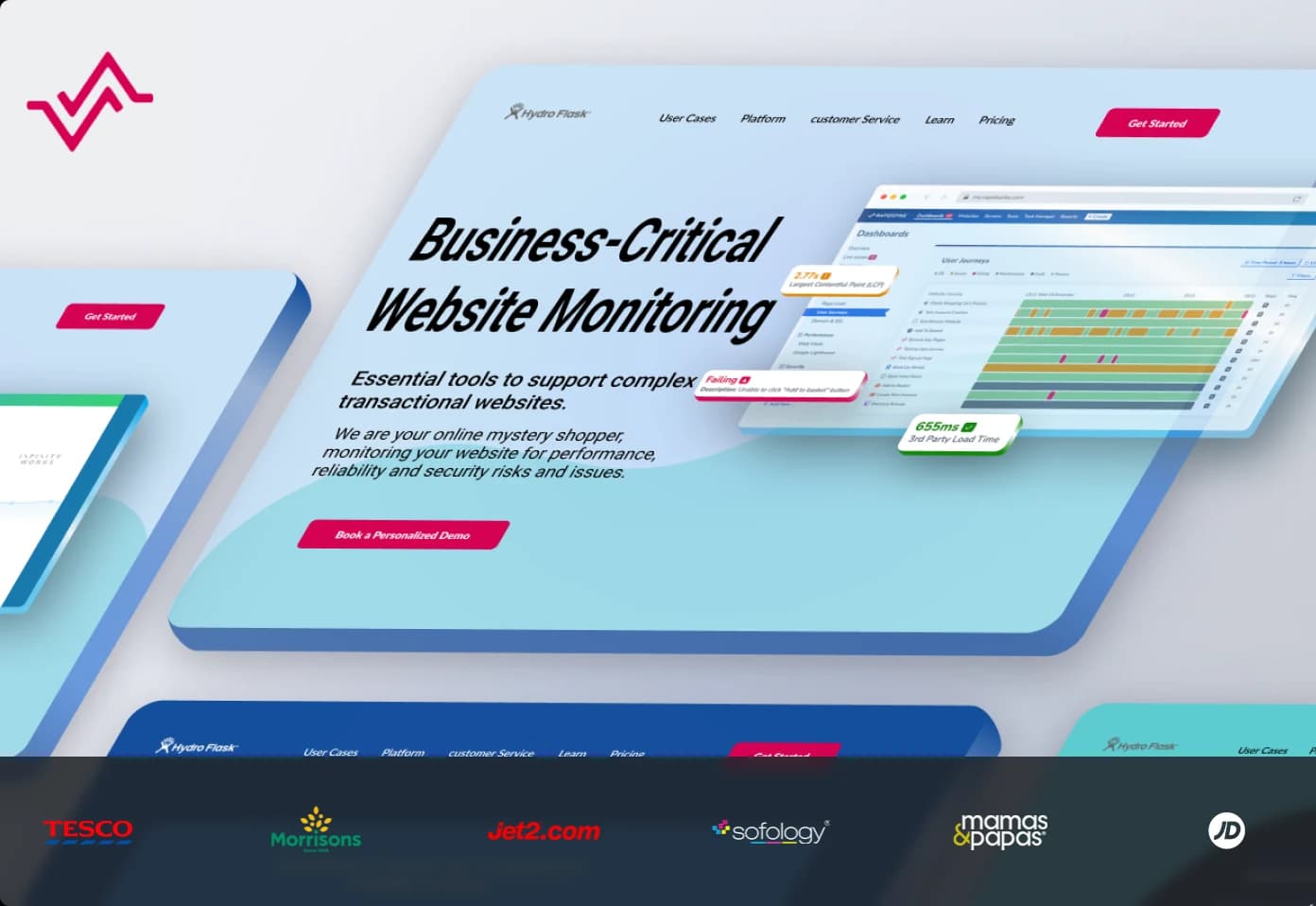
Rapid Spike is Business-Critical Website Monitoring & Security Solution. Our Biggest Clients are TESCO, MORRISONS, Jet2.com, JD, MAMAS & PAPAS, and many more. Built with high standards for performance, security, and intuitive user experiences, the platform is engineered to support mission-critical workflows and seamless scale.
What was the problem or pain point
Client Dilemma & Technical Bottleneck
RapidSpike protects some of the UK's largest digital retail brands, including Tesco, Morrisons, and Jet2.com. The primary challenge was that enterprise clients were suffering from undetected client-side Magecart and digital skimming attacks — where malicious third-party scripts steal customer credit card details directly inside the browser DOM without touching server-side logs. Simultaneously, their legacy synthetic monitoring infrastructure struggled under the weight of executing millions of high-frequency transactional checks every minute across distributed regional networks, resulting in database bottlenecks, delayed incident alerting, and high cloud compute overhead.
What we suggested to the client
Solid Sphere Architectural Recommendation
Solid Sphere recommended architecting a dual-track telemetry platform: a decoupled, distributed event-driven ingestion pipeline powered by Apache Kafka to handle high-frequency synthetic telemetry, coupled with a headless browser sandbox inspection engine specifically engineered to intercept DOM-level data exfiltration and unauthorized script mutations in real time. We also proposed modernizing the customer-facing analytics dashboard into a reactive Angular application backed by Redis caching layers to ensure that enterprise security teams could query multi-gigabyte historical uptime and vulnerability datasets in sub-second timeframes.
What made this project challenging
Handling continuous high-frequency synthetic checks for major retail clients like Tesco and Morrisons
Detecting web skimming (Magecart) and third-party script vulnerabilities in real time
Maintaining 99.999% platform availability across multi-region AWS cloud instances
Processing billions of metrics daily with sub-second dashboard query response times
What was implemented and how it was implemented
Step-by-Step Technical Execution
We implemented a globally distributed cluster of synthetic testing probes using containerized Node.js headless Chromium runners deployed across multiple AWS availability zones. Each runner executed realistic multi-step user journey scripts — adding products to carts, navigating checkout funnels, and monitoring network requests for unauthorized endpoint calls. To detect digital skimming, we built a script execution analyzer that hooked into browser DOM APIs, monitoring changes to script tag attributes, content security policy (CSP) violations, and outbound POST payloads containing cardholder patterns. Telemetry was streamed into an Apache Kafka cluster, processed by asynchronous consumer workers, and persisted into time-partitioned storage with Redis caching for real-time aggregation. The front-end was built in Angular, delivering interactive latency heatmaps, real-time alert dispatch configuration, and executive SLA compliance reporting.
How we delivered
Modernized existing telemetry architecture with distributed Kafka ingestion and Redis caching
Developed advanced synthetic user journey monitoring workers simulating checkout flows
Engineered real-time Magecart security scanning engine with instant anomaly notifications
Built interactive Angular dashboards with latency heatmaps and customizable client reporting
What did we use to implement it
Technology Stack & Technical Rationale
Angular was selected for the dashboard because of its enterprise-grade dependency injection, strict TypeScript typings, and high performance when rendering complex SVG heatmaps and streaming data grids. Node.js with Puppeteer drove the synthetic browser automation fleet due to lightweight asynchronous I/O and low memory footprints during continuous headless test cycles. PHP powered legacy core API endpoints and customer account logic with robust stability, while Apache Kafka provided the fault-tolerant, high-throughput message bus necessary to ingest tens of thousands of telemetry events per second. Redis was utilized as an ultra-fast in-memory cache and rate limiter, and AWS Multi-Region VPC infrastructure guaranteed high availability and disaster recovery meeting strict enterprise SLAs.
Key outcomes
Over 1 Billion monthly uptime checks
Trusted by Tesco, Morrisons, and Jet2
Zero undetected downtime incidents
99.999% platform SLA maintained
Have a project like this?
Share your goals and constraints. We'll respond with next steps and a practical proposal.