Stanford University
Shaping the Future of Medicine Through Premier Education and Innovation
Project overview
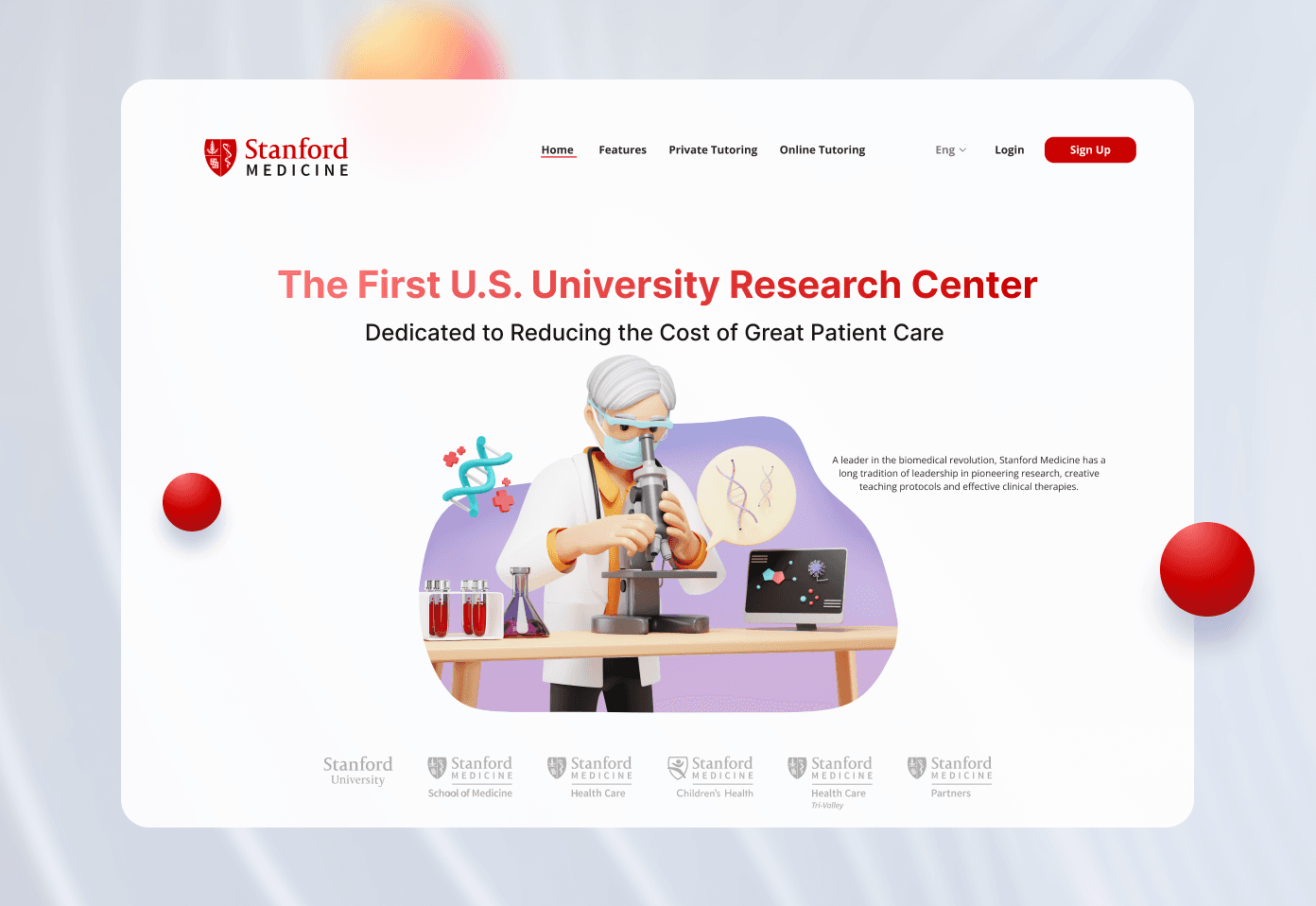
Stanford University is Shaping the Future of Medicine Through Premier Education and Innovation. Stanford Medicine offers cutting-edge education programs in medicine and health sciences. Built with high standards for performance, security, and intuitive user experiences, the platform is engineered to support mission-critical workflows and seamless scale.
What was the problem or pain point
Client Dilemma & Technical Bottleneck
Stanford University's clinical research and medical education divisions required an advanced, high-interactivity digital education portal for specialized global surgical fellowships and medical student training. Standard learning management systems (Canvas, Blackboard) were static and text-heavy, unable to support multi-angle 4K surgical video streaming, synchronized slide annotations during live lectures, or interactive clinical diagnostic simulations with real-time feedback.
What we suggested to the client
Solid Sphere Architectural Recommendation
Solid Sphere proposed building a bespoke medical educational platform combining high-definition adaptive video streaming, an interactive collaborative Canvas annotation layer, synchronized lecture chaptering, and automated competency assessments for medical fellows and clinical students.
What made this project challenging
Designing a premier interactive medical education portal for Stanford School of Medicine
Supporting high-resolution surgical video streaming with timestamped clinical annotations
Delivering interactive clinical diagnostic case simulations where students make treatment choices
Ensuring seamless single sign-on integration with Stanford University SUNet ID authentication
What was implemented and how it was implemented
Step-by-Step Technical Execution
We developed the web platform using Next.js with TypeScript and TailwindCSS, creating a distraction-free, highly accessible academic learning environment. We engineered an adaptive bitrate video streaming player capable of rendering synchronized multi-angle surgical camera feeds (laparoscopic view and operating room overview simultaneously). We integrated the HTML5 Canvas API and WebSockets to allow professors and students to annotate video frames in real time during live or recorded lectures, highlighting anatomical landmarks and surgical planes. We developed an interactive clinical case evaluation module where students review patient histories, order diagnostic tests, and select surgical interventions, with automated scoring based on clinical guidelines. The system was integrated with Stanford's single sign-on (SSO) and Canvas LMS via LTI (Learning Tools Interoperability) standards, and deployed on secure AWS infrastructure.
How we delivered
Engineered responsive medical curriculum portal with interactive patient case branching scenarios
Built custom HTML5 surgical video player supporting frame-by-frame scrubbing and expert commentary
Integrated Stanford SUNet ID via SAML 2.0 single sign-on with role-based access control
Developed clinical competency assessment engine tracking student diagnostic decision accuracy
What did we use to implement it
Technology Stack & Technical Rationale
Next.js and TypeScript provided server-rendered academic pages, instant navigation, and robust type safety. TailwindCSS enabled a refined, accessible visual design compliant with Stanford digital brand guidelines and WCAG AA standards. HTML5 Canvas API and WebSockets powered real-time collaborative video frame annotation. PostgreSQL stored student performance analytics, interactive case states, and course modules. AWS CloudFront and S3 provided global low-latency delivery of high-bitrate surgical video archives.
Key outcomes
Used by over 2,500 Stanford medical students and faculty
Over 500 interactive clinical case modules created and deployed
98% student satisfaction rating for virtual surgical learning
Recipient of educational innovation recognition
Have a project like this?
Share your goals and constraints. We'll respond with next steps and a practical proposal.