RG Nets
A network for Telcos, Airports, and big businesses.
Project overview
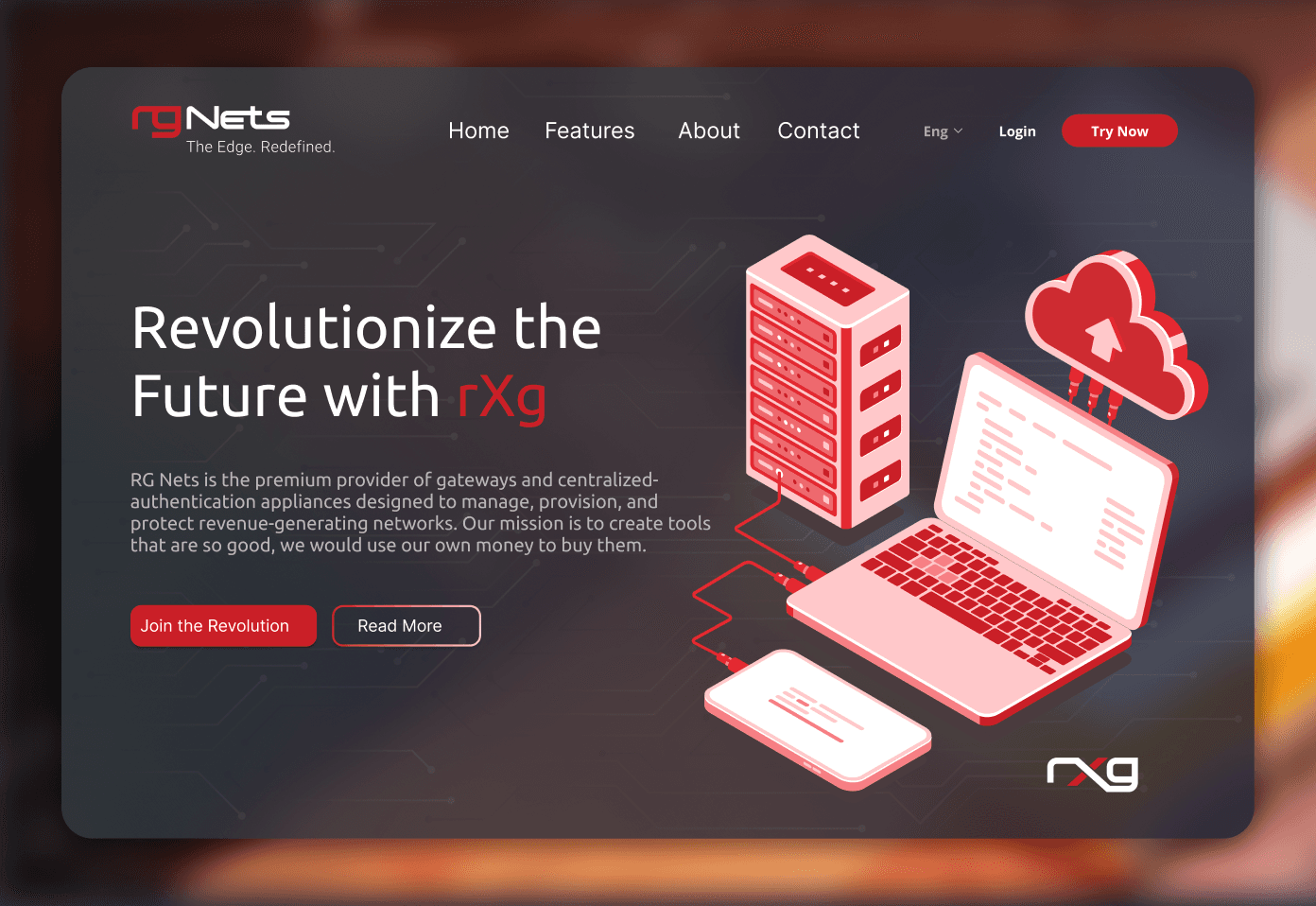
RG Nets is A network for Telcos, Airports, and big businesses. A network for service providers to maximise revenue, minimise cost and easily scale. Built with high standards for performance, security, and intuitive user experiences, the platform is engineered to support mission-critical workflows and seamless scale.
What was the problem or pain point
Client Dilemma & Technical Bottleneck
RG Nets develops the revenue generating gateway controller (rXg), a high-throughput carrier-grade network gateway used in enterprise hospitality, universities, and telecom operators. The client needed to modernize their web management portal and enhance deep packet inspection (DPI) reporting capabilities. With thousands of concurrent network devices routing gigabits of bandwidth through each gateway, existing monitoring dashboards suffered from high CPU overhead, slow page loads, and dropped SNMP telemetry under heavy connection saturation.
What we suggested to the client
Solid Sphere Architectural Recommendation
Solid Sphere recommended refactoring the rXg administrative console and telemetry pipeline. We suggested optimizing the integration between low-level FreeBSD and Linux kernel networking hooks (PF/ipfw, eBPF, Netflow) and the higher-level Ruby on Rails web application. By replacing heavy polling with zero-copy shared memory queues and event-driven data streaming, the gateway could visualize bandwidth consumption, captive portal authentications, and policy enforcement without degrading network throughput.
What made this project challenging
Controlling massive carrier-grade network gateways for airports, hotels, and telecom operators
Processing line-rate packet inspection and AAA (Authentication, Authorization, Accounting) flows
Managing complex multi-tenant billing, bandwidth throttling, and captive portal redirections
Ensuring zero packet loss under peak loads of tens of thousands of concurrent device connections
What was implemented and how it was implemented
Step-by-Step Technical Execution
We collaborated closely with RG Nets network engineers to build high-performance C-extensions that interface directly with kernel-level packet filter statistics and routing tables, buffering metrics in shared memory rings. We revamped the Ruby on Rails management interface, introducing asynchronous background workers to aggregate telemetry into time-series buckets without blocking UI threads. We developed responsive, real-time network topology visualizers and bandwidth usage monitors using modern frontend charting libraries, enabling network administrators to define traffic shaping rules, configure captive portals for hotel guests, and inspect VLAN assignments with immediate feedback. System reliability and regression test suites were automated to validate FreeBSD and Linux kernel compatibility across diverse enterprise hardware configurations.
How we delivered
Architected web management control plane interfacing with low-level FreeBSD and Linux kernel drivers
Engineered customizable captive portal engine supporting multi-tier hotel and airport Wi-Fi billing
Optimized database indexing and queries for millions of real-time session records and bandwidth logs
Implemented enterprise PMS (Property Management System) integrations for automated room charging
What did we use to implement it
Technology Stack & Technical Rationale
C was used for low-level systems programming, kernel hooks, and packet filter integration to guarantee zero network latency penalty. Ruby on Rails powered the administrative application, policy configuration engine, and RESTful management APIs. FreeBSD and Linux kernel networking subsystems (ipfw, PF, iptables) provided line-rate packet routing and traffic shaping. PostgreSQL handled relational configuration data, device MAC address tables, and billing rules.
Key outcomes
Deployed in major international airports and 5-star hotel chains
Supports 100,000+ simultaneous active sessions per gateway
Sub-millisecond captive portal redirection speed
Carrier-grade 99.999% network uptime reliability
Have a project like this?
Share your goals and constraints. We'll respond with next steps and a practical proposal.