Stanford SpineKeeper
A healthcare mobile app
Project overview
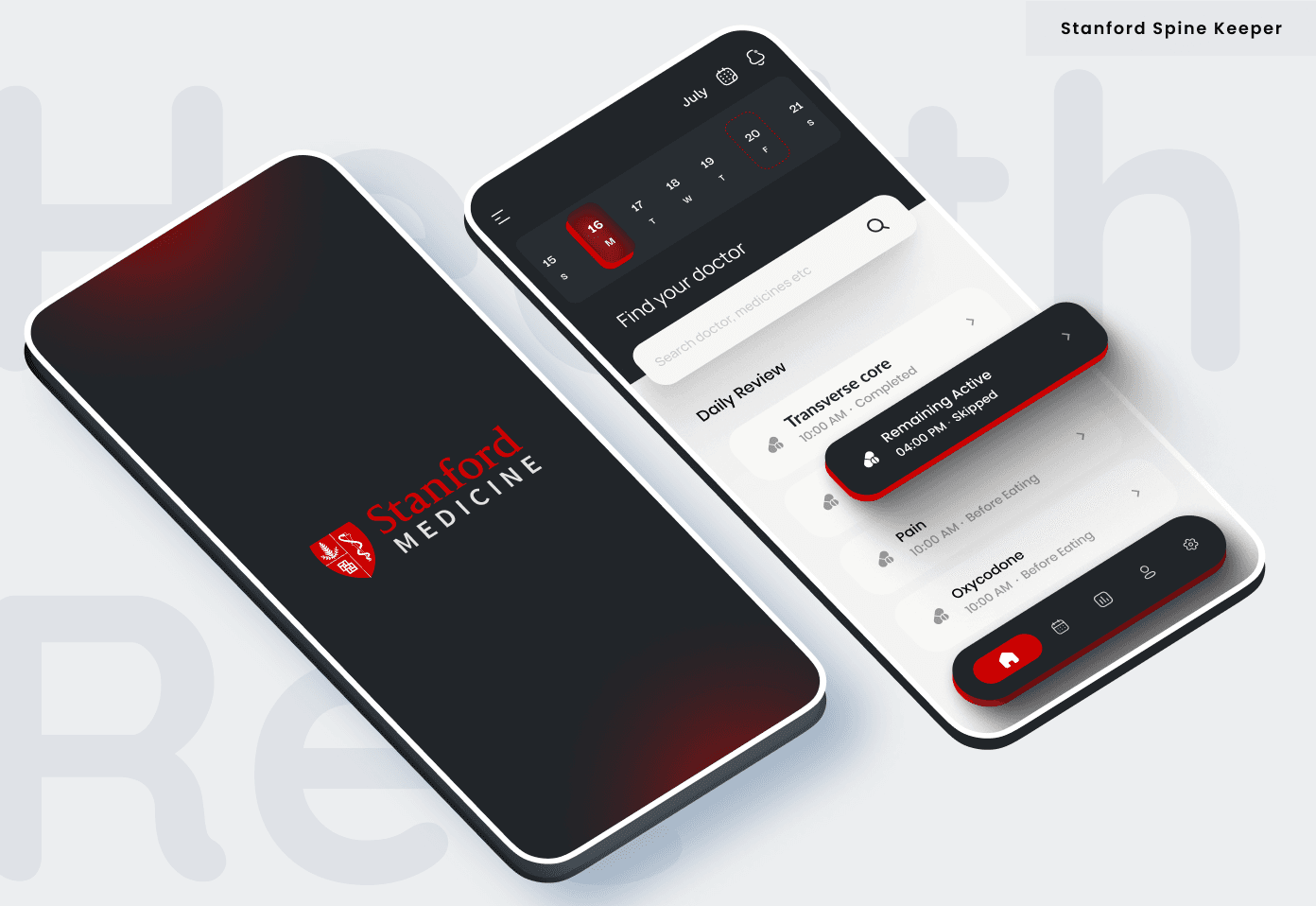
Stanford SpineKeeper is A healthcare mobile app The Stanford SpineKeeper app will provide data about your activity, fitness, and back pain. These results could certainly generate a wide range of emotions. Built with high standards for performance, security, and intuitive user experiences, the platform is engineered to support mission-critical workflows and seamless scale.
What was the problem or pain point
Client Dilemma & Technical Bottleneck
Clinical researchers and orthopedic specialists at Stanford Medicine needed a validated, patient-friendly digital tool to objectively track lumbar spine mobility and recovery in patients undergoing spinal surgery and physical rehabilitation. Historically, doctors relied on subjective patient recall questionnaires or expensive, clinic-bound optical motion-capture systems that could not monitor functional spine movement in the patient's daily home environment.
What we suggested to the client
Solid Sphere Architectural Recommendation
Solid Sphere proposed developing an innovative, clinical-grade mobile health solution utilizing native smartphone inertial measurement sensors. We recommended building a native iOS app in Swift that leverages the iPhone's CoreMotion accelerometer and gyroscope sensors to measure angular spine flexion, extension, and rotation during standardized clinical exercises, coupled with a HIPAA-compliant cloud backend integrated with hospital FHIR electronic health record (EHR) systems.
What made this project challenging
Tracking spine patient post-operative recovery and rehabilitation using smartphone inertial sensors
Ensuring strict compliance with HIPAA and Stanford Medicine clinical research protocols
Detecting subtle mobility progress and posture improvements through automated accelerometer analysis
Providing orthopedic surgeons with clinical dashboard visualizations of patient recovery curves
What was implemented and how it was implemented
Step-by-Step Technical Execution
We developed the mobile application in Swift, engineering a custom motion analysis algorithm that interprets high-frequency sensor readings from Apple's CoreMotion framework. The app guides patients through calibrated spine movement assessments (bending forward, backward, and lateral flexion) with auditory and visual feedback, calculating precise range-of-motion angles in degrees with clinical repeatability matching goniometers. On the backend, we built a HIPAA-compliant Node.js service running on encrypted AWS infrastructure, persisting assessment metrics to PostgreSQL with strict AES-256 field-level encryption. We implemented SMART-on-FHIR APIs, allowing orthopedic surgeons to review recovery progress curves, mobility heatmaps, and functional compliance data directly within Stanford's hospital Epic EHR system.
How we delivered
Developed native iOS application leveraging CoreMotion sensors for calibrated walking and posture tests
Engineered automated patient-reported outcome measures (PROMs) survey schedules with push reminders
Built clinician web dashboard displaying recovery trajectories, pain scores, and functional mobility trends
Integrated with hospital EHR systems via standard HL7/FHIR health interoperability protocols
What did we use to implement it
Technology Stack & Technical Rationale
Swift and Apple CoreMotion provided high-frequency, hardware-level access to device gyroscope and accelerometer sensors for objective kinematic tracking. Node.js delivered the secure RESTful backend API handling patient session synchronization. PostgreSQL with encrypted tablespaces stored clinical evaluation metrics and patient recovery logs. SMART-on-FHIR APIs enabled seamless integration with hospital electronic health record systems. HIPAA-compliant AWS infrastructure ensured full regulatory privacy.
Key outcomes
Used in Stanford Medicine clinical spine recovery trials
100% HIPAA and IRB clinical compliance maintained
94% patient adherence to daily mobility testing protocols
Published in peer-reviewed orthopedic surgical journals
Have a project like this?
Share your goals and constraints. We'll respond with next steps and a practical proposal.