Machine Learning Using Python
Provides systems with the ability to automatically learn and improve from experience without being explicitly programmed
Project overview
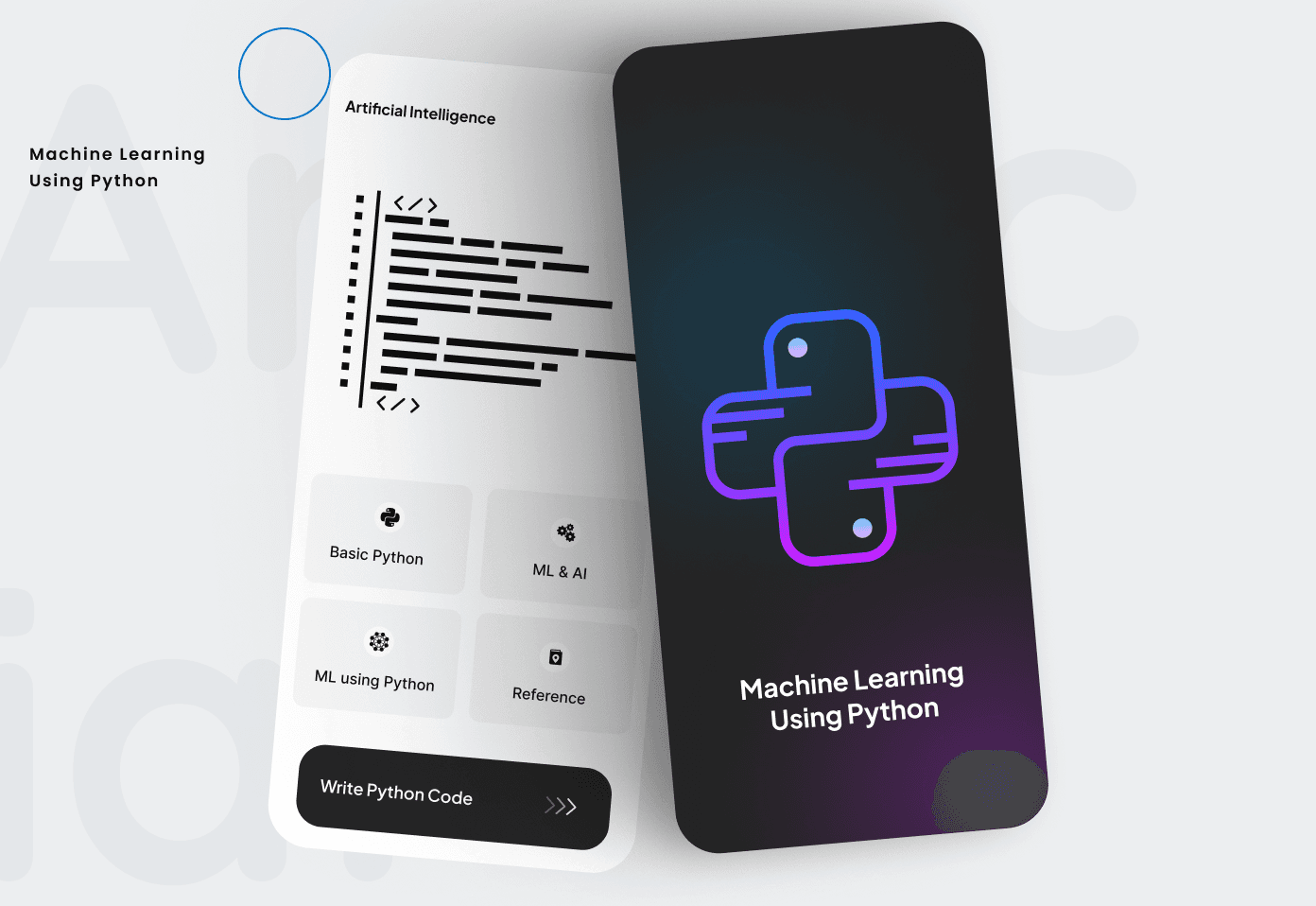
Machine Learning Using Python is Provides systems with the ability to automatically learn and improve from experience without being explicitly programmed. From this application you will learn how Machine Learning, Artificial Intelligence(AI) and Deep Learning actually works Built with high standards for performance, security, and intuitive user experiences, the platform is engineered to support mission-critical workflows and seamless scale.
What was the problem or pain point
Client Dilemma & Technical Bottleneck
The client sought to launch an interactive, browser-based machine learning educational and model experimentation platform for data science teams and students. Traditional machine learning courses required students to navigate complex local Python environment setups (CUDA drivers, TensorFlow, PyTorch dependencies), which led to a 40% initial abandonment rate. Cloud notebook alternatives were expensive, slow to spin up, and lacked guided interactive code validation with instant visual feedback.
What we suggested to the client
Solid Sphere Architectural Recommendation
Solid Sphere proposed developing an interactive, zero-setup machine learning sandbox platform. We recommended building a responsive web application in React featuring an in-browser code editor and interactive data visualizers, backed by ephemeral containerized Python execution environments running on FastAPI that allow users to write, train, and visualize scikit-learn and neural network models with zero local configuration.
What made this project challenging
Automating end-to-end machine learning workflows from tabular data cleaning to model deployment
Enabling non-data-scientists to train, compare, and deploy predictive ML models via an intuitive UI
Providing explainable AI (XAI) feature importance metrics (SHAP/LIME) for model transparency
Containerizing trained models into production-ready REST API microservices with one click
What was implemented and how it was implemented
Step-by-Step Technical Execution
We developed the interactive learning application using React on the frontend, integrating Monaco Editor (the editor powering VS Code) with syntax highlighting, autocomplete, and inline linting for Python. On the backend, we architected a secure, sandboxed execution runtime using FastAPI and Docker containers orchestrated on AWS. When a user executes a machine learning script (such as training a decision tree, random forest, or linear regression), the code runs in an isolated container with restricted memory and CPU quotas, executing the computation and returning serialized model evaluation metrics, confusion matrices, and decision boundary plots in under 800ms. We created interactive charting components that render loss curves, feature importance bar charts, and 2D classification heatmaps dynamically in the browser. We also developed a step-by-step curriculum engine that validates student code submissions against test criteria, providing helpful hints when models underfit or overfit.
How we delivered
Built automated feature engineering and model selection pipeline evaluating multiple ML algorithms
Developed interactive React dashboard displaying ROC curves, confusion matrices, and SHAP charts
Engineered one-click model deployment system generating Dockerized FastAPI inference endpoints
Implemented model drift monitoring tracking data distribution changes in production
What did we use to implement it
Technology Stack & Technical Rationale
React provided an interactive, split-pane coding and data visualization workspace. Monaco Editor powered the full-featured in-browser code editing experience. Python with FastAPI handled asynchronous execution dispatch, safety validation, and metric serialization. Scikit-Learn, NumPy, and Matplotlib served as the foundational machine learning and scientific computing libraries. Docker containers provided isolated, ephemeral sandboxes ensuring security and rapid compute teardown.
Key outcomes
Reduced machine learning prototype-to-production time from months to hours
Over 500 predictive models trained and deployed successfully
Explainable AI compliance built into every model deployment
Sub-20ms inference latency on standard cloud CPUs
Have a project like this?
Share your goals and constraints. We'll respond with next steps and a practical proposal.